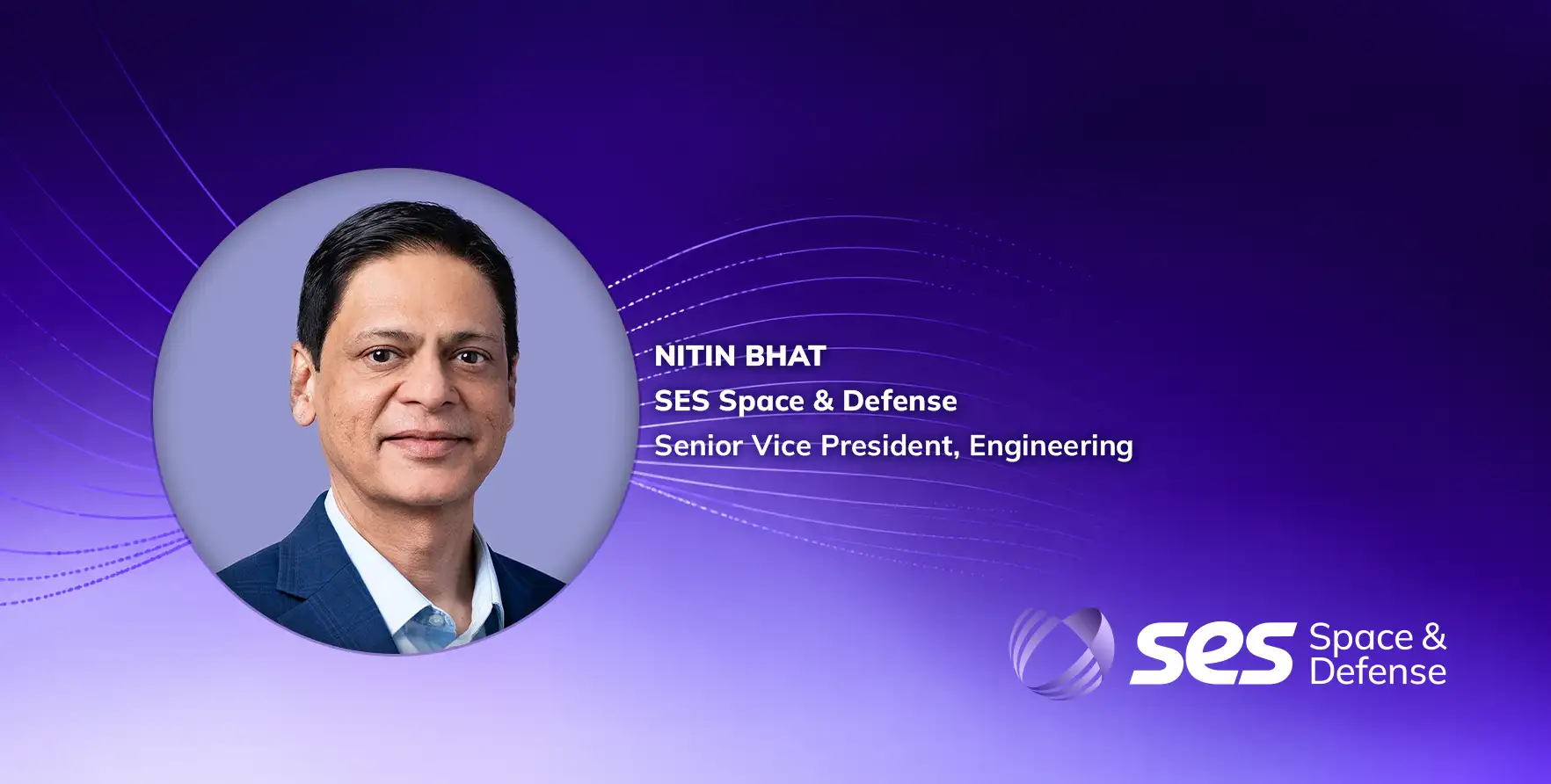
by Nitin Bhat, Senior Vice President, Engineering at SES Space & Defense
What is your role and the function of the engineering team at Space & Defense?
I lead the SES engineering team and run our centers of excellence, which are the specialized functions that support both our internal and external customers. When we win a new program, my team manages execution from a technical standpoint and works closely with our customers to support their missions. We serve as an escalation point when issues arise as well as a point of contact when the customer wants to add new features or services. Internally, we collaborate with and provide technical expertise to teams across the organization, including business development, strategy and innovation.
How does the engineering team ensure customers have continuous access to reliable communications?
We work to identify and implement the best technical solution to meet the unique customer requirements at hand. Whereas some companies have separate teams for solution design and implementation, our approach ensures that the same team responsible for developing the solution also oversees its deployment. We work closely with our parent company to offer solutions leveraging our MEO, GEO, and partner LEO constellations. In all cases, we ensure that the processes we undertake internally to deliver solutions are horizontal and seamless to both our internal and external customers.
How has increased demand for resilient critical communications impacted your team and your day-to-day work?
The toolkits for our customers’ adversaries have changed. Resiliency today means ensuring our customers can achieve their missions when faced with any number of changing conditions and challenges, which could include someone trying to degrade communications capabilities. We do this by offering multi-orbit and multi-band solutions, relaying data between our different constellations, and using orchestration to switch between ground and satellite networks in different ways. In an environment where achieving mission success is getting harder, we continuously identify and propose new options to our customers to maximize resilience.
How does Space & Defense incorporate security into solutions to protect customers from increasingly sophisticated threats?
As the need for resiliency has increased in recent years, so has the requirement for solutions and systems to interconnect. The opportunity for an adversary to interfere with connectivity or steal technology has increased as a result. AI has also made it much easier for adversaries to find and exploit vulnerabilities. To combat these challenges, we build in security at every layer of our solutions, systems, and software. We maintain rigorous security standards in protecting sensitive government information, as reflected in our adherence to CMMC Level 2 cybersecurity requirements. We provide constant training to ensure our people follow security policies and procedures. As it relates to AI, we have increased the frequency of software patching to enhance protection. Together, these measures strengthen our overall security posture, enhance resilience against evolving threats, and ensure our systems can withstand and recover from potential attacks.
What should prospective customers know about the expertise and capabilities of the Space & Defense engineering team?
As missions become increasingly complex, we have expanded and strengthened our expertise across a broad range of domains including space, systems, networks, cloud, ground infrastructure, software, and cybersecurity. Our depth of expertise enables us to address evolving customer requirements and deliver differentiated capabilities that support mission success. For example, our ICT Portal provides internal and external customers with a centralized platform to monitor systems, regardless of whether they are operating on MEO, GEO, or LEO satellite networks. Our technical expertise and understanding of complex mission requirements ultimately allow us to deliver the high-performing solutions our customers require.
What do you see as the most important engineering and security priorities for Space & Defense in the coming years?
Our team is continuously adapting to the changing needs of our business and customers. As governments increasingly rely on commercial partners, adopt contractor-operated models, and invest in sovereign capabilities, we must continue to strengthen our expertise in systems engineering, digitization, virtualization, cloud technologies, and network orchestration. At the same time, we need to harness AI to accelerate service delivery and conquer the cyber threat. My focus will be on ensuring that we continue to level up our expertise to adapt to these new models and today’s realities.